|
 Prek
Toal Bird Sanctuary Prek
Toal Bird Sanctuary
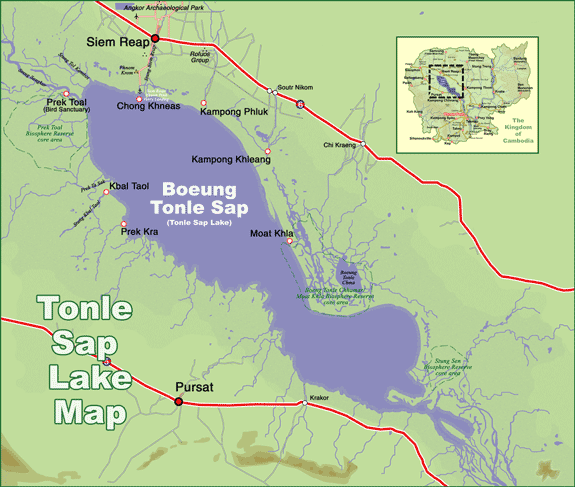
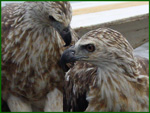
The sanctuary at the Prek Toal core area of the Biosphere Reserve has
been called "the single most important breeding ground in Southeast Asia
for globally threatened large waterbirds." The Biosphere covers 31,282
hectares at the northwest tip of the Lake and plays host to species
including Greater and Lesser Adjuncts, Black-headed Ibis, Painted Stork,
Milky Stork, Spot-billed Pelican, Grey-Headed Fish Eagle and many more
species. Of the three Biosphere core areas on the Tonle Sap Lake, Prek
Toal is the most accessible from Siem Reap and the most popular with
birdwatchers. The best time of year for viewing is the dry season
(December-May) when flocks of migratory birds congregate at Prek Toal.
As the dry season progresses and the water recedes, the number of birds
increases but the travel to some of the more important viewing areas
becomes more difficult.
Arrange a trip to Prek Toal through your guesthouse or a tour operator.
To do it yourself, take a moto or taxi from Siem Reap to the Chong
Khneas boat dock. Arrange a boat to the Prek Toal Environmental Research
Station (starting at $60 return,) a $20 entrance fee and $30 for a
guided boat tour of the sanctuary. The Research Station has information
on the area's flora and fauna. There are also basic overnight
accommodations if you want to stay the night to take full advantage of
the sunset and early morning viewing hours.
|
More Bird Watching
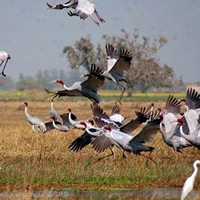
Away from the lake, northwest of Siem Reap the Ang Trapeng Thmor
Sarus Crane Reserve offers another unique birdwatching
opportunity.
Ang Trapeng Thmor Sarus Crane Reserve
(The following about Ang Trapeng Thmor comes courtesy of the Sam
Veasna Center.) Originating as a reservoir on the Angkorian highway
66 it was rebuilt as a man-made irrigation and water storage reservoir
by slave labor during the Khmer Rouge Regime in 1976. The reservoir now
harbors a unique wetland associated with grassland, dipterocarp forests
and paddy fields. Aside from being a feeding ground for more than 300
Sarus Crane in the dry (non-breeding) season, more than 200 species of
other birds occur here, of which 18 have been classified as globally or
near globally threatened. This is also one of the handful of sites in
Cambodia where the endangered Eld’s Deer can be seen. Colonies of fruit
bats inhabit larger trees that are often semi submerged on the edge of
the reservoir.
The best time to see the Sarus Crane is from February to May though an
abundance of bird species can be viewed all year. There is also a hill
top Angkorian temple a few kilometers into the forest while traditional
silk weaving is still practiced in the adjacent village. A boat trip can
be taken on the reservoir which depending on the time of year is 11km
along and 8 wide and offers fantastic views of the surrounding
countryside
Officially declared a Sarus Crane Reserve by Royal Decree in 2000 the
area designated covers over 12000 Hectares, following the work of Sam
Veasna and his friends at the Wildlife Conservation Society (WCS),
all foreign visitors are required are required to register at the WCS
Office in the adjacent village.
ATT is a day trip from Siem Reap though accommodation can be
arranged at the WCS HQ (Tel: +(855)(0)12-703033) or organized through the Sam
Veasna Center in Siem Reap (Tel: +(855)(0)92-554473,
+(855)(0)63-963710) in the adjacent village,
giving birdwatchers the chance of dawn sightings and offering the
opportunity of visiting the massive Angkorian temple complex of Banteay Chma |
 Chong
Khneas Chong
Khneas
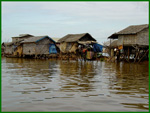
Chong Khneas is the floating village at the edge of the lake closest and
most accessible to Siem Reap. If you want a relatively quick and easy
look at the Tonle Sap, boat tours of Chong Khneas are available,
departing from the Chong Khneas boat docks all day long. Take a tuk-tuk
or taxi the 11-15km from Siem Reap to the docks where there are always
boats waiting for passengers. Boat pricing is variable, traditionally by
the boat, but they’ll charge up to $20/pax.
The boatman will probably point out the
differing Khmer and Vietnamese floating households and the floating
markets, clinics, schools and other boatloads of tourists. Chong Khneas,
while interesting, is over-touristed and is not as picturesque as
floating villages further afield. The trip usually includes a couple of
stops - usually one a touristy floating 'fish and bird exhibition' with
a souvenir and snack shop. Sometimes they will also try to get you to
agree to stop at a school or orphanage, which we do not recommend.
Ask the operator to skip this part of the tour.
 Kampong
Phluk Kampong
Phluk
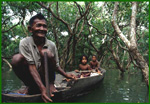
Kampong Phluk is a cluster of three villages of stilted houses built
within the floodplain about 16 km southeast of Siem Reap. The villages
are primarily Khmer and have about 3000 inhabitants between them.
Flooded mangrove forest surrounds the area and is home to a variety of
wildlife including crab-eating macaques. During the dry season when the
lake is low, the buildings in the villages seem to soar atop their
6-meter stilts exposed by the lack of water. At this time of year many
of the villagers move out onto the lake and build temporary houses. In
the wet season when water level rises, the villagers move back to their
permanent houses on the floodplain, the stilts now hidden under the
water. Kampong Phluk's economy is, as one might expect, based in
fishing, primary in shrimp harvesting.
Kampong Phluk sees comparatively few foreign visitors and offers a close
look at the submerged forest and lakeside village life. The area can be
reached by boat from the Chong Khneas or by road. It’s easiest to make
arrangements through a tour operator, or if you are good at bargaining
charter a boat at the Chong Khneas docks. During the wet season, drive
to Roluos village just off Route #6 east of Siem Reap and then take a
boat through the flooded forest the rest of the way. During the dry
season the road is clear, making the boat unnecessary.
 Kampong
Khleang Kampong
Khleang
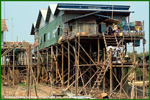
Kampong Khleang is located on the northern lake-edge about 35 km east of
Siem Reap. It is more remote and less touristed than Kam-pong Phluk.
Visitors during the dry season are universally awestruck by the forest
of stilted houses rising up to 10 meters in the air. In the wet season
the waters rise to within one or two meters of the buildings. Kampong
Khleang is a permanent community within the floodplain of the Lake, with
an economy based in fishing and surrounded by flooded forest. But
Kampong Khleang is significantly larger with near 10 times the
population of Kampong Phluk, making it the largest community on the
Lake.
The area can be reached by boat from the Chong Khneas docks or by a
combination of road to Domdek on Route #6 and then boat to the village,
the best method depending on the time of year. During the dry season,
boats cannot get all of the way to the main villages. Consult your
guesthouse or tour operator about current conditions. Many tour
operators have very little experience in this area so it is best to
consult with adventure tour operators and guesthouses that specialize in
this area.
To get there yourself, either charter a boat from Chong Khneas or take
car or moto to Domdek village on Route #6 east of Siem Reap, turn south
and continue to the water's edge where boats wait to ferry passengers
into the village. During the dry season the road is clear and you can
take a car or moto all of the way to the village.)
Mechrey
Mechrey is a floating village about 15km north of Chong Khneas, about
half way to Prek Toal. The village’s economy is based primarily in
fishing, and quite a few farm crocodiles as well. In recent years
Mechrey has also opened itself to eco-tours, welcoming tours of the
village and area. There is also a fair bit of wild bird life in the
area. Not as good as Prek Toal, but cheaper and easier to get to.
Tour Operators
Cambodian Travel Partner
Tonle Sap Lake tours, Jeep tours,
countryside tours
Tel: +(855)(0)63-963242
www.cambodia-travelpartner.com
Discover Asia Pacific Travel & Tour
Taphul Road,
Siem Reap
Tel: +(855)(0)63-760476
Hidden Cambodia Adventure Tours
Single and multi-day all-inclusive, high end, cultural, adventure and humanitarian tours by 4WD vehicles, dirt bike and car to Koh Ker, Preah Vihear, Preah Khan temples and historic KR area,
Anlong Veng. Tonle Sap Lake tours.
Just off the road to Angkor Wat,
Siem Reap
Tel: +(855)(0)12-655201
+(855)(0)12-934412
hiddencambodia@yahoo.com
www.hiddencambodia.com
Kampoul Adventure Tour
Cultural and adventure tours. Tonle Sap Lake tours.
#0593, Wat Bo Road,
Siem Reap
Tel: +(855)(0)63-760909
+(855)(0)63-965865
www.adventure.com.kh
Komnob Airboat Tours
Running unique airboat tours. Skim
across the Tonle Sap to visit floating and lake’s edge villages and
a crocodile farm.
Tel: +(855)(0)12-926966, +(855)(0)16-988896
www.komnobairboattours.com
Prek Toal Tours & Travel
Locally owned and operated tour
operator, offering several tours, excursions and experiences on the
Tonle Sap Lake. Bird watching at Prek Toal, cultural tours or
floating and stilted village, eco-tours, custom arrangements.
Wat Damnak village, Sala Komruek Commune, Siem Reap
Tel: +855-77 797112
Mob: +855-93-707667
bookings@prektoal-tours.com
http://prektoal-tours.com
Sam Veasna Center (SVC)
Sam Veasna Center (SVC) organizes half or full day trips focusing
on birds but offering a glimpse of Cambodian rural life with a
trained local guide. SVC was set up to promote wildlife conservation
in Cambodia. It works together with the Wildlife Conservation
Society and local village communities to develop remote sites close
to the habitat of some spectacular bird life. The local communities
benefit from the infrastructure set up for the visitors. Trips to
see Sarus Crane at Ang Trapaeng Thmor, Giant and White Shouldered
Ibis at Tamtboey, A vulture restaurant at Chhep amongst others, plus
some of the most beautiful and unspoiled countryside in Cambodia.
Tel: +(855)(0)92-554473,
+(855)(0)63-963710
info@samveasna.org
www.samveasna.org
Tara River Boat
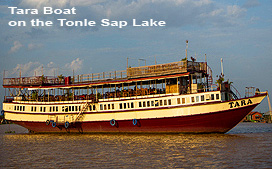
Tara Riverboat operates both half day trips and sunset tours of
Chong Khneas floating village and stops at the Gecko Environmental
Centre fish and a crocodile farm along the way. Meals and drinks are
served on the boat. All boat tours include pick up and return to
hotels and a guide. Price for half day 9:00AM - 12:00PM $29/person,
10:00AM - 2:00PM $32/person and sunset is
3:30PM - 7:30PM $38/person. The sunset cruise includes all drinks including
unlimited champagne, wines, beers, etc. and a 2 course meal. Tours
to Prek Toal (bird sanctuary,) and Kampong Phluk, Kampong Khleang
(traditional lake villages) and Battambang also available. These
tours also include food, drinks, pick up and return to hotel in an
a/c car. Price for Prek Toal tour is $165/person. The Kampong Phluk
for half day 8:30AM - 1:00PM $38/person, full day 10:00AM - 4:00PM
$58/person and sunset 1:00PM - 7:30PM $68/person. Tailored adventure tours on request.
Located at Chong Khneas floating village,
Siem
Reap
Tel: +(855)(0)92-957765
info@taraboat.com
www.taraboat.com
Terre Cambodge/Biking Cambodia
Mountain bike (TREK, GIANT) and trekking
specialist. Overnights. Tonle Sap Lake boat tours (bird sanctuary,
floating and stilted villages,) elephant trekking and more. Tailor made
itineraries.
#R-30, Rolous Street - Borei Prem Prei,
Siem Reap
Tel: +(855)(0)77-448255
+(855)(0)92-476682
www.terrecambodge.com
www.bikingcambodia.net
Triple A Adventures
Floating village and Kampong Khleng
tours. Bicycle tours.
Tel: +(855)(0)88-8366004
www.tripleacambodia.com
|









 the lake. The inflow expands the area of lake more than
five-fold, inundating the surrounding forested floodplain and supporting
an extraordinarily rich and diverse eco-system.
the lake. The inflow expands the area of lake more than
five-fold, inundating the surrounding forested floodplain and supporting
an extraordinarily rich and diverse eco-system.