 |


|
|
|
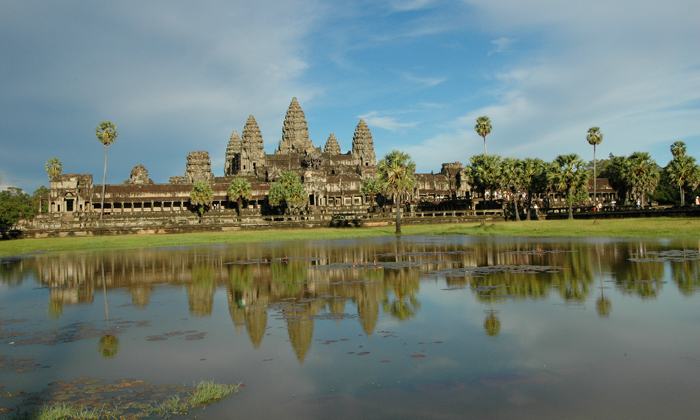
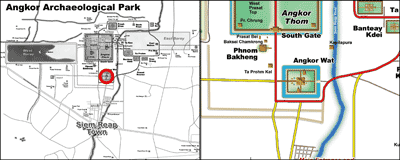 Angkor
Wat is visually, architecturally and artistically breathtaking. It is a
massive three-tiered pyramid crowned by five lotus-like towers rising 65
meters from ground level. Angkor Wat is the centerpiece of any visit to
the temples of Angkor. Angkor
Wat is visually, architecturally and artistically breathtaking. It is a
massive three-tiered pyramid crowned by five lotus-like towers rising 65
meters from ground level. Angkor Wat is the centerpiece of any visit to
the temples of Angkor. At the apex of Khmer political and military dominance in the region, Suryavarman II constructed Angkor Wat in the form of a massive 'temple-mountain' dedicated to the Hindu god, Vishnu. It served as his 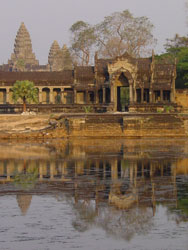 state temple, though the temple’s uncommon westward orientation has led
some to suggest that it was constructed as Suryavarman II’s funerary
temple. Other temples of the same style and period include Thommanon,
Banteay Samre, Wat Atwea and Beng Melea, which may have served as a
prototype to Angkor Wat. state temple, though the temple’s uncommon westward orientation has led
some to suggest that it was constructed as Suryavarman II’s funerary
temple. Other temples of the same style and period include Thommanon,
Banteay Samre, Wat Atwea and Beng Melea, which may have served as a
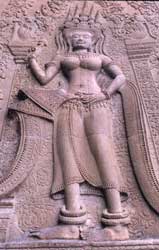
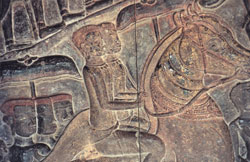
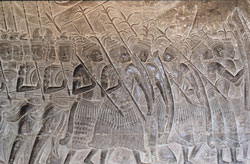
prototype to Angkor Wat.Angkor Wat is surrounded by a moat and an exterior wall measuring 1300 meters x 1500 meters. The temple itself is 1 km square and consists of three levels surmounted by a central tower. The walls of the temple are covered inside and out with bas-reliefs and carvings. Nearly 2000 distinctively rendered apsara carvings adorn the walls throughout the temple and represent some of the finest examples of apsara carvings in Angkorian-era art. But it is the exterior walls of the lower level that display the most extraordinary 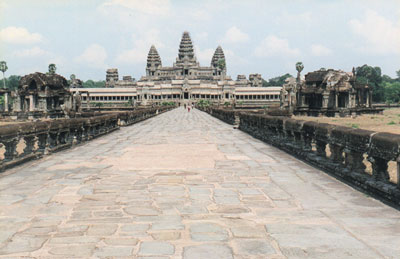 bas-reliefs, depicting stories and
characters from Hindu mythology and the historical wars of Suryavarman
II. It is in the viewing of the bas-reliefs that a tour guide can be
very helpful. bas-reliefs, depicting stories and
characters from Hindu mythology and the historical wars of Suryavarman
II. It is in the viewing of the bas-reliefs that a tour guide can be
very helpful. The first level of is the most artistically interesting. Most visitors begin their exploration with the bas-reliefs that cover the exterior wall of the first level, following the bas-reliefs counterclockwise around the temple. Bas-relief highlights include the mythological Battle of Kuru on the west wall; the historical march of the army of Suryavarman II, builder of Angkor Wat, against the Cham, followed by scenes from Heaven and Hell on the south wall; and the classic ‘Churning of the Ocean Milk’ on the east wall. The temple interior is not as densely carved as the first level exterior, but still sports hundreds of fine carvings of apsaras and scenes from Hindu mythology. A guide can be quite helpful in explaining the stories of the various chambers, statues and architectural forms to be found in the interior. At the upper-most of your tour of the temple, the central tower on the third level houses four Buddha images, each facing a 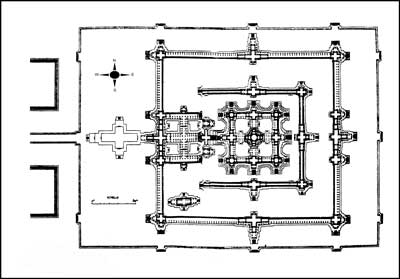 different cardinal point, highlighting the fact that though
Angkor Wat was constructed as a Hindu temple, it has served as a
Buddhist temple since Buddhism became Cambodia’s dominant religion in
the 14th century. Some say that it is good luck to pay homage to all
four Buddha images before departing Angkor. different cardinal point, highlighting the fact that though
Angkor Wat was constructed as a Hindu temple, it has served as a
Buddhist temple since Buddhism became Cambodia’s dominant religion in
the 14th century. Some say that it is good luck to pay homage to all
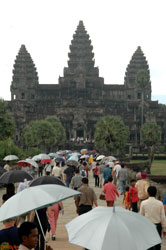
four Buddha images before departing Angkor.The northern reflecting pool in front of Angkor Wat is the most popular (and crowded) sunrise location. The sun rises behind Angkor Wat providing a silhouette of the temple’s distinctively shaped towers against a colored sky. Some of the best colors appear just before the sun breaks over the horizon. The visual impact of Angkor Wat, particularly on one's first visit, is awesome. As you pass through the outer gate and get your first glimpse, its size and architecture make it appear two dimensional, like a giant postcard photo against the sky. After you cross through the gate and approach the temple along the walkway it slowly gains depth and complexity. To maximize this effect you should make your first visit in optimal lighting conditions, after 2:00PM when the sun is on the face of the temple. Do not make your first visit to Angkor Wat in the morning when the backlighting obscures the view. |
|
Apsara Carving |
Main causeway - Mid-day |
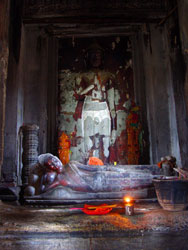
Reclining Buddha - Third Level |
|
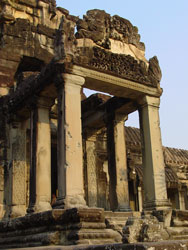
Battle Damage - West-facing door |
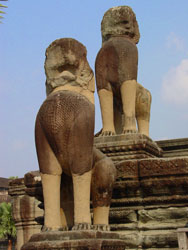
Lions |
Exterior Wal |
|
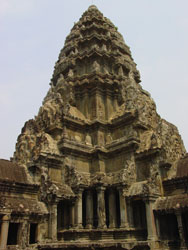
Tower |
|
|
 |
 |
